The Met Office were reporting yesterday that this April may have been the warmest and driest in the UK on record. Judging by the record amount of electricity I harvested, it may also have been the sunniest.
Now this time last year I'd admit that I had less PV installed. The last lot of BP panels were installed in May and I had about 1.50kWp installed in total. But the fact that I have just over 2kWp installed this April doesn't account for the power harvest being 2.9 times higher than the previous year.
The upshot has been that my solar system has offset just over 53% of my total electricity demand for the month, and up to 66% of weekly demand in the best week of the month (the last week). On a daily basis, the best day was the 28th, with over 85% of electrical demand served by solar power.
Quite astonishing, given that I didn't install the upgraded capacity from the recent haul of solar panels until the middle of he month.
The newly upgraded immersion heater controller is also maybe having an impact, as it can more effectively use the spare power available in the system.
Everything about my home made solar power system and green things in general.
Use the information in this blog at your own risk.
Showing posts with label Home made. Show all posts
Sunday, May 1, 2011
Wednesday, April 27, 2011
Dual Power Immersion Heater
The automatic load controller for my immersion heater has been working pretty well. It turns on and off with the varying power of the Sun. But it left something to be desired when the battery was starting the absorb cycle.
The battery consumed quite a lot of power, but not all of it. The immersion heater needed 650W to run, so couldn't. The result was a period of under utilised solar power in the late mornings, with a trace that looks like this:
By modifying the step down transformer supply for the heater, I created a dual power heater. I step down the AC Voltage from the solar inverter with a 4kVA "tool transformer". It outputs 110V AC from the 230V AC input. This runs the 3kW heater element at just 650W.
Under software control from the PC load manager, the first relay turns the heater on and off, while a new second relay selects the power level of the heater, depending on the solar power available.
I added a pair of 6A diodes in parallel (for power handling, as the peak current when the heater is on is about 8.4A). This converts the 110V AC into half-wave rectified DC. The diodes are rated at 600V so they are pretty bullet proof. This has the effect of reducing the power consumption of the heater from 650W to just 350W; measured with an AC plug-in power meter at the 230V AC input to the transformer.
The thermostat switch on the heater ordinarily wouldn't like DC power, as it would cause arcing when the contacts open, and this would soon destroy the thermostat. But as this is half-wave DC, it still has the periods of zero Voltage in each 50Hz cycle, so the thermostat contacts can open and close as normal without arcing.
I then had to modify the control software to take advantage of the new dual power heater.
I decided to ditch the purely light level & system power level threshold system, for one that attempts to estimate the array power available for driving the heater loads (at two power levels).
It has a seed value that is the expected array power (the "system size"). It then applies a self tuning modifier to that base value (plus/minus 200W) and then multiplies that by the measured light strength from the new sensor (as a percentage). This gives me the estimated "array power". The "system power" is the real measured output power from the Morningstar charge controller log data. This includes all loads: battery charge load, other loads (e.g. the fridge), as well as the heater load (if it happens to be on).
By comparing the real power output during times when the battery is likely to be fully loading the array with the estimated "array power", the self tuning parameter adjusts the estimate up or down, so that the estimate gets better. It has some limits set in the routine, so that it does not tune the estimate at very low light levels that would never be enough to drive the heater load. It also has some fuzziness in the tuning so that if it is within 1% of the real power, it stops hunting. If the tuning parameter gets bigger than 200W variance, it starts to modify the base assumption about the "system size", saving the change in a config file for next time the program runs.
Most of the estimate tuning happens in the MPPT bulk charge phase, as that is when the battery will absorb all the power the array can muster, and so the "system power" should equal the estimated "array power". The idea is that the tuning parameter will compensate for the distributed orientation of the panels (some are East-West, some are South, some are at steep angles, some at shallow angles). The system will also "learn" how dirty the array is (if there has been no rain for a while, and dust has collected on the panels).
The final step is that when the battery enters the absorption phase, the program looks at the estimated array power and subtracts the current "system power", which includes all non-heater loads plus charge demand, and calculates the "available power" for running the heater load. If the "available power" is greater than the low (350W) heater setting, but less than the high (650W) heater setting, it turns the heater on, and selects "low power" mode (the diode bypass relay is energised and the normally closed contacts change to be open). If the "available power" is higher than the high power setting, the diode bypass relay is de-energised, the contacts revert to the normally closed position, and the heater receives the full 110 V AC power.
The resulting power utilisation is more even, with the heater able to use low levels of available power and maintain the tank temperature. 350W is enough to very slowly heat the water, or at least compensate for losses through the insulation. It all helps. When it's sunny enough, and the other loads are low enough, the heater can run at full power (650W).
The above trace also shows the water heater interacting with the cyclic load of the fridge freezer. While the recorded system power varies considerably, note that the battery is given priority in attaining full charge and holding a steady float Voltage for as long as possible.
During the absorption and float stages of battery charge, the heater decision process also includes some "array power" estimate tuning. If the heater repeatedly has to reduce power to low power, the tuning parameter slowly drifts downwards. If the heater has to be shut off due to low power, the parameter decreases more quickly. As a last resort, if the battery Voltage actually drops below the float threshold set in the load controller, then a much more severe adjustment of the parameter occurs. This behaviour means that on clear sunny days, the heater is given priority and has a tendency to stay on. On days with very changeable weather, the heater progressively errs on the side of caution, becoming less and less likely to turn on and more likely to turn off or remain in low power mode. This favours maintaining the battery charge level.
Use of a half-wave rectifier at high power (350W is a significant load) is normally frowned upon, as it presents a very non-linear AC power load (only half the cycle is used). The plug-in AC meter did show a very bad power factor (PF = 0.5). This would result in power being wasted in the wiring and generator as reactive power (current out of phase with the Voltage). But the 3kW inverter is stable into any power factor load (inductive or capacitive), and in the end, the source of the power is a DC battery or solar panel. With the very large capacitors in the inverter input (for surge delivery), the DC source is not aware of the non-linear AC load, and merely sees a useful reduction in load. The "bad" AC load does consume more of the available VA capacity of the inverter than a good power factor load would, but provided the total VA load is less than the permissible load, no harm is done.
The battery consumed quite a lot of power, but not all of it. The immersion heater needed 650W to run, so couldn't. The result was a period of under utilised solar power in the late mornings, with a trace that looks like this:
![]() |
| Click to view bigger |
Under software control from the PC load manager, the first relay turns the heater on and off, while a new second relay selects the power level of the heater, depending on the solar power available.
I added a pair of 6A diodes in parallel (for power handling, as the peak current when the heater is on is about 8.4A). This converts the 110V AC into half-wave rectified DC. The diodes are rated at 600V so they are pretty bullet proof. This has the effect of reducing the power consumption of the heater from 650W to just 350W; measured with an AC plug-in power meter at the 230V AC input to the transformer.
The thermostat switch on the heater ordinarily wouldn't like DC power, as it would cause arcing when the contacts open, and this would soon destroy the thermostat. But as this is half-wave DC, it still has the periods of zero Voltage in each 50Hz cycle, so the thermostat contacts can open and close as normal without arcing.
I then had to modify the control software to take advantage of the new dual power heater.
I decided to ditch the purely light level & system power level threshold system, for one that attempts to estimate the array power available for driving the heater loads (at two power levels).
![]() |
| Click to view bigger |
It has a seed value that is the expected array power (the "system size"). It then applies a self tuning modifier to that base value (plus/minus 200W) and then multiplies that by the measured light strength from the new sensor (as a percentage). This gives me the estimated "array power". The "system power" is the real measured output power from the Morningstar charge controller log data. This includes all loads: battery charge load, other loads (e.g. the fridge), as well as the heater load (if it happens to be on).
By comparing the real power output during times when the battery is likely to be fully loading the array with the estimated "array power", the self tuning parameter adjusts the estimate up or down, so that the estimate gets better. It has some limits set in the routine, so that it does not tune the estimate at very low light levels that would never be enough to drive the heater load. It also has some fuzziness in the tuning so that if it is within 1% of the real power, it stops hunting. If the tuning parameter gets bigger than 200W variance, it starts to modify the base assumption about the "system size", saving the change in a config file for next time the program runs.
Most of the estimate tuning happens in the MPPT bulk charge phase, as that is when the battery will absorb all the power the array can muster, and so the "system power" should equal the estimated "array power". The idea is that the tuning parameter will compensate for the distributed orientation of the panels (some are East-West, some are South, some are at steep angles, some at shallow angles). The system will also "learn" how dirty the array is (if there has been no rain for a while, and dust has collected on the panels).
The final step is that when the battery enters the absorption phase, the program looks at the estimated array power and subtracts the current "system power", which includes all non-heater loads plus charge demand, and calculates the "available power" for running the heater load. If the "available power" is greater than the low (350W) heater setting, but less than the high (650W) heater setting, it turns the heater on, and selects "low power" mode (the diode bypass relay is energised and the normally closed contacts change to be open). If the "available power" is higher than the high power setting, the diode bypass relay is de-energised, the contacts revert to the normally closed position, and the heater receives the full 110 V AC power.
The resulting power utilisation is more even, with the heater able to use low levels of available power and maintain the tank temperature. 350W is enough to very slowly heat the water, or at least compensate for losses through the insulation. It all helps. When it's sunny enough, and the other loads are low enough, the heater can run at full power (650W).
![]() |
| Click to view bigger |
During the absorption and float stages of battery charge, the heater decision process also includes some "array power" estimate tuning. If the heater repeatedly has to reduce power to low power, the tuning parameter slowly drifts downwards. If the heater has to be shut off due to low power, the parameter decreases more quickly. As a last resort, if the battery Voltage actually drops below the float threshold set in the load controller, then a much more severe adjustment of the parameter occurs. This behaviour means that on clear sunny days, the heater is given priority and has a tendency to stay on. On days with very changeable weather, the heater progressively errs on the side of caution, becoming less and less likely to turn on and more likely to turn off or remain in low power mode. This favours maintaining the battery charge level.
Use of a half-wave rectifier at high power (350W is a significant load) is normally frowned upon, as it presents a very non-linear AC power load (only half the cycle is used). The plug-in AC meter did show a very bad power factor (PF = 0.5). This would result in power being wasted in the wiring and generator as reactive power (current out of phase with the Voltage). But the 3kW inverter is stable into any power factor load (inductive or capacitive), and in the end, the source of the power is a DC battery or solar panel. With the very large capacitors in the inverter input (for surge delivery), the DC source is not aware of the non-linear AC load, and merely sees a useful reduction in load. The "bad" AC load does consume more of the available VA capacity of the inverter than a good power factor load would, but provided the total VA load is less than the permissible load, no harm is done.
Sunday, April 17, 2011
Some More Piccys
A couple more piccys of my upgraded PV arrays.
As well as the movable ones, pointing largely West to extend the generating day almost to sunset, I also rotated the Sharp array on the garage roof to the S-SW a bit. In the early morning, it didn't generate much, as there is some shading from trees to the West. In the late afternoon, the power would drop off too, as the sun soon goes round to an oblique angle. So, rotating it S-SW a bit flattens out the mid-day power curve of the whole system, and extends the peak power generating time longer into the afternoon.
Saturday, April 16, 2011
Breaking the 2kWp Barrier
Some nice weather this week meant a spot of gardening and some more woodwork...
The other 48Wp amorphous array has been upgraded to 160Wp, using a couple of the new Klearskies panels. That leaves four more lolling about in the living room, waiting for a place to go. :D
The nearer one is the new one, and I move it around in the day, depending on how low the battery was from the previous night, or if the weather is forecast to be sunny only in the morning, or only the afternoon. This brings the total installed capacity up to 2080Wp.
I can't actually use all of it at the same time as the Morningstar TriStar MPPT controller is only rated for 60A at 24V, or some 1600W (they seem to rate it for the float Voltage of 27V on a 24V system). I've got 1740Wp installed (would generate just over 64A), but it points in different directions, so will never make the total power at the same time. Orienting the panels in different directions just extends the time that the whole system runs without using the battery, and gives the battery the best chance of reaching full charge.
It's been incredibly sunny the last few days, and I've been able to move the 160W mobile array to track the sun from the SE in the morning, to the setting Westerly light, further increasing the "battery free" run time.
The other 48Wp amorphous array has been upgraded to 160Wp, using a couple of the new Klearskies panels. That leaves four more lolling about in the living room, waiting for a place to go. :D
The nearer one is the new one, and I move it around in the day, depending on how low the battery was from the previous night, or if the weather is forecast to be sunny only in the morning, or only the afternoon. This brings the total installed capacity up to 2080Wp.
I can't actually use all of it at the same time as the Morningstar TriStar MPPT controller is only rated for 60A at 24V, or some 1600W (they seem to rate it for the float Voltage of 27V on a 24V system). I've got 1740Wp installed (would generate just over 64A), but it points in different directions, so will never make the total power at the same time. Orienting the panels in different directions just extends the time that the whole system runs without using the battery, and gives the battery the best chance of reaching full charge.
It's been incredibly sunny the last few days, and I've been able to move the 160W mobile array to track the sun from the SE in the morning, to the setting Westerly light, further increasing the "battery free" run time.
Wednesday, March 23, 2011
New Solar Sensor (again...)
Lately, the tupperware solar sensor that is supposed to measure the available solar power to control my solar water heater has been playing up. Sometimes reading zero in full sunlight or other wonky values that didn't seem right. It also was too directionally sensitive - a feature of the old solar panel used that has micro lenses on it that focus the light - but only when it shines square on to the panel. Also the box itself was possibly causing some shading or variation in light getting through. On closer inspection, the UV had destroyed the tupperware, making it crack and go brittle.
So the search was on for a small sensor that will be weather proof and less directionally sensitive. The local Robert Dyas had the perfect bit of bodgineering raw material... a £1.49 solar garden path LED lantern spike thingy.
It had a little amorphous solar panel on the top and all the bits came apart easily to leave the plastic and stainless steel capsule on its own. I could just rip out the little circuit board with the LED and battery, and connect the wires from the solar panel across a 100 Ohm resistor load in a chocblock (so that the device measures solar power). Then I just had to hot glue up the holes on the base to prevent water getting in. The hole where the LED came out was just the size to fill with a rubber blanking grommet.
Some of the existing holes, that were used for the clear lantern bit to snap on to, were also handy for threading the plastic cable tie through. I mounted the new capsule sensor on a handy hanging basket bracket that was already on the wall when we moved into the house. This, by sheer coincidence, is at the same angle as the main solar panels.
The amorphous panel has no outer window or lens to restrict the angle of light acceptance and amorphous panels are less sensitive to direction anyway, so it seems to give a good reading through the day.
The output Voltage was a little lower than the old sensor, so I had to recalibrate the measuring software on the load controller to get a proper 100% reading in full sunlight. In the end, I decided it would be easier to modify the software to have a user parameter for the sensor scaling, avoiding the need for recompiling the program just to change the value. Amorphous panels put out up to 20% more power when new, but quickly settle down to their usual power when exposed to the sun for a few weeks, so it made sense to change the software to allow tuning the sensor. I even added new today and yesterday counters for the heater run time and estimated kWh of DC power generated.
I've even got the (still working) white LED, solar controller chip, NiMH coin cell and on/off switch gubbins that I can play with. Most of that would be worth at least £2-3 if I'd bought it from Maplins. So the solar panel was actually "free".
Oh, yeah... Like my new multimeter? It's an antique Micronta (Tandy) analogue (but with FET inputs) 1980's test meter that I picked up at a car boot the other week. Nowhere as accurate or convenient as a DMM but looks "retro-cool".
The new sensor has been working better than I expected, and now the water heater works really well. Getting good heating yields but not cycling the battery much at all.
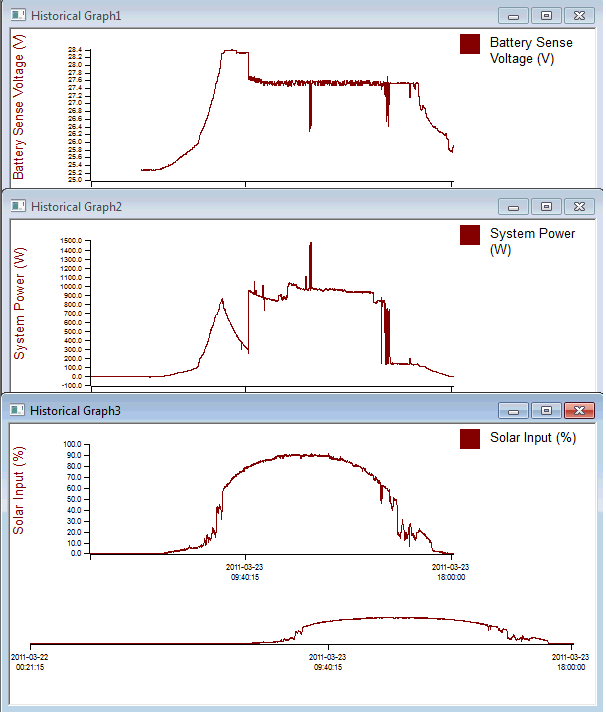
Here you can see the results of a totally blue sky day on the right of the graphs... Even on the not so good day, the battery Voltage holds up pretty well with the more accurate solar power availability estimate. Click on the chart below to see it in full size.
Today's trace (on the right) was the first full solar hot water day of the year. You can just see there were no clouds at all by the totally smooth sensor trace. No gas used today, and 48'C water in the tank :D.
So the search was on for a small sensor that will be weather proof and less directionally sensitive. The local Robert Dyas had the perfect bit of bodgineering raw material... a £1.49 solar garden path LED lantern spike thingy.
It had a little amorphous solar panel on the top and all the bits came apart easily to leave the plastic and stainless steel capsule on its own. I could just rip out the little circuit board with the LED and battery, and connect the wires from the solar panel across a 100 Ohm resistor load in a chocblock (so that the device measures solar power). Then I just had to hot glue up the holes on the base to prevent water getting in. The hole where the LED came out was just the size to fill with a rubber blanking grommet.
Some of the existing holes, that were used for the clear lantern bit to snap on to, were also handy for threading the plastic cable tie through. I mounted the new capsule sensor on a handy hanging basket bracket that was already on the wall when we moved into the house. This, by sheer coincidence, is at the same angle as the main solar panels.
The amorphous panel has no outer window or lens to restrict the angle of light acceptance and amorphous panels are less sensitive to direction anyway, so it seems to give a good reading through the day.
The output Voltage was a little lower than the old sensor, so I had to recalibrate the measuring software on the load controller to get a proper 100% reading in full sunlight. In the end, I decided it would be easier to modify the software to have a user parameter for the sensor scaling, avoiding the need for recompiling the program just to change the value. Amorphous panels put out up to 20% more power when new, but quickly settle down to their usual power when exposed to the sun for a few weeks, so it made sense to change the software to allow tuning the sensor. I even added new today and yesterday counters for the heater run time and estimated kWh of DC power generated.
I've even got the (still working) white LED, solar controller chip, NiMH coin cell and on/off switch gubbins that I can play with. Most of that would be worth at least £2-3 if I'd bought it from Maplins. So the solar panel was actually "free".
Oh, yeah... Like my new multimeter? It's an antique Micronta (Tandy) analogue (but with FET inputs) 1980's test meter that I picked up at a car boot the other week. Nowhere as accurate or convenient as a DMM but looks "retro-cool".
The new sensor has been working better than I expected, and now the water heater works really well. Getting good heating yields but not cycling the battery much at all.
Here you can see the results of a totally blue sky day on the right of the graphs... Even on the not so good day, the battery Voltage holds up pretty well with the more accurate solar power availability estimate. Click on the chart below to see it in full size.
Today's trace (on the right) was the first full solar hot water day of the year. You can just see there were no clouds at all by the totally smooth sensor trace. No gas used today, and 48'C water in the tank :D.
Sunday, October 3, 2010
Dodgy Plastic Panels...
Hmmm... I'm glad I sold off most of the plastic framed amorphous panels. One of the two remaining ones broke the other day. It suddenly went open circuit. Rather than bin it, I decided to take it to bits to see how they were put together.
The black caps on the back hide a load of small screws that hold the thing together. Luckily, the sealant that was under the cover wasn't glue so I could easily take the back off of the panel. Under the silicone sealant on the positive lead, the end contact on the glass had broken off and the red wire came away with the sealant it was embedded in. This was possibly from thermal stress as I remember hearing the frames creaking in the sun and shade.
There was a thin stub of copper poking out from under the laminate. The panel seems to be made from a sandwich of two plates of glass (presumably with one having the amorphous cells evaporated on to it). I just about managed to solder a thin wire on to this and then joined it to a new thicker wire and potted the whole thing in silicone sealant again before screwing the back on. How long will it last? Who knows...
To save propping up the thing on a garden chair, I made up a rear leg, just fixed on with the usual brass hinge.
Now that it's getting darker in the days, it's actually better to have the amorphous panels at a shallow angle as they produce more power from just "seeing" more diffuse light from a bigger proportion of the sky than if you aim them at the non-existent Sun.
The black caps on the back hide a load of small screws that hold the thing together. Luckily, the sealant that was under the cover wasn't glue so I could easily take the back off of the panel. Under the silicone sealant on the positive lead, the end contact on the glass had broken off and the red wire came away with the sealant it was embedded in. This was possibly from thermal stress as I remember hearing the frames creaking in the sun and shade.
There was a thin stub of copper poking out from under the laminate. The panel seems to be made from a sandwich of two plates of glass (presumably with one having the amorphous cells evaporated on to it). I just about managed to solder a thin wire on to this and then joined it to a new thicker wire and potted the whole thing in silicone sealant again before screwing the back on. How long will it last? Who knows...
To save propping up the thing on a garden chair, I made up a rear leg, just fixed on with the usual brass hinge.
Now that it's getting darker in the days, it's actually better to have the amorphous panels at a shallow angle as they produce more power from just "seeing" more diffuse light from a bigger proportion of the sky than if you aim them at the non-existent Sun.
Tuesday, June 8, 2010
How to Bodge Ammeters
One of the big problems you have when putting together a battery based solar system is measuring where the juice is going. You need to know whether it's going in the battery or to the inverter and how fast it's going.
For this you need low loss ammeters. You need ammeters that can measure maybe 100-200A without causing much voltage loss. You can buy shunts that you can connect in series with cables to read the current but this means more joins in the cable and each join adds resistance that causes loss. Shunts are also mostly of the type that create a Voltage of 50mV per 500 Amps passing through them which is quite a small signal when most of the time you'll be measuring a few 10's of Amps. They're also quite expensive...
Enter the In-Line Bodger's Shunt... :D
Solar battery systems by necessity need to be connected together by big fat cables to carry the heavy current without losing Volts ('coz we're working at maybe only 12V or 24V). Any bit of copper cable (no matter how thick) will have a resistance and so make a voltage across it's length when a current flows. Even the cheapest digital multimeter will read down to 0.1mV (they all have a 200mV range). So all you need to do to measure the current in a cable is attach some sensor wires to the cable at a distance apart that causes some useful Voltage to be developed relative to the current.
I have two types of in line shunt in my system. One uses a long spacing (about 50cm on a 10mmsq cable) to give a reading of 1mV per Amp. On my big group of four 6V batteries, I made one of the huge 35mmsq link cables that join the blocks a bit longer than the others - just enough to make 0.1mV per Amp when I soldered the sensor wires at the lug ends. So that DMM reads 0.1 for 1A and 1.0 for 10A - you just have to ignore the decimal point on the display.
This one's a shorty as it's on a bit of 6mmsq cable.
It should go without saying (but I'll say it anyway) that you should only do this on low voltage DC power cables. Don't try it on mains AC lines, as a) it won't work and b) you'll probably get electrocuted and die.
All you need to do is connect another DMM with a 10A current range in series with the cable in question and arrange for a few Amps to pass through it. Then solder a sensor wire to the fat cable and using a pin, poke the cable at different places until you find the distance that gives you 0.1mV per Amp reading on the new meter. Then you can either cut the insulation away at that point and solder the other sensor wire in there or sometimes on big 35mmsq cables you can just solder the sensor wire to the head of a drawing pin and just stick the pin into the cable at the spot. Tape it up with electrical tape and run the sensor wires to where you want to see the meter. It can be some distance away (like a couple of meters) as the sensor wires carry no current so won't lose any volts on the way (the DMM input is usually about 10MOhms so the fraction of one Ohm on the sensor wire makes no difference).
Here you can see my three bodged ammeters. The top and left ones read net battery current in or out of the two main banks at 0.1mV per A (so showing 3A charge each) and the third one reads the current from the smaller Morningstar MPPT15 charge controller at 1mV per A (so showing 2.0A charge). The big Morningstar TriStar has a built in meter so I didn't need to bodge a fourth meter. The meters are arranged so that positive readings mean charge current and negative readings means discharge current.
Ok, these shunts aren't going to be super accurate and the short (or fat) ones will only read to a resolution of 1A but mostly that's all you need to know - whether the battery is charging or discharging and by roughly how much (some Amps or lots of Amps).
Maybe most importantly, it can tell you when there are no Amps flowing as that tells you two things: a) something is busted or b) the battery has finished absorbing power and is full. In a system like mine with several batteries, it also tells me how well (or otherwise) the batteries are sharing the load or charge... More on this in the next post!
Thursday, May 20, 2010
The Story So Far... (part 3)
Having gotten bored of running up the stairs to turn on and off the water heater, I started looking around for a way to do this automatically.
The answer came in the form of a Velleman kit from Maplins called snappily a K8055 USB experiment interface. It allows a PC to read switches and sensors and then output signals or turn on / off relay switches. You can get them either pre-made or in kit form and you have to solder it together yourself. I chose the kit version as it's £10 cheaper.
After putting it all together, it looks something like this...
The inputs are the terminal blocks on the left (two analogue inputs of 0-5V and four inputs for switches). The kit actually included little press buttons to test it with but I didn't bother installing them. On the right are the outputs (8 on/off outputs with LEDs and two analogue outputs of either 0-5V or PWM of 0-100%).
The latter could be used to dim a light or even a heater by varying the duty cycle of power to the load and using thyristor to chop the power.
A CD comes with the board that has the Windows DLL that makes it work and an example program in various languages. I had an old copy of Visual Basic 6 sitting around and it works fine with this. To make my program to control the heater, I just took the demo program and modified it a bit.
In order to control the heater so that it only used spare solar power and not battery power, I needed to measure several things:
I didn't want to run Ethernet cable all over the house so I used a pair of Ethernet over Power plugs. These just plug into spare power sockets and then carry data over the house wiring. Very handy. This then plugs into an old 10Mbit hub as I also have a couple of computers in the living room and an IP CCTV camera outside.
One of the computers is an old Toshiba laptop that I bought at a car boot sale a couple of years ago for £5. It works and with a new battery bought off the internet, it even runs better than new. It only has Windows 98 but I managed to find an old Ethernet card for it - would you believe from another pair of laptops I bought at a car boot sale for £5. Those laptops were a bit broken but work now and the Ethernet card was free. The Toshiba can't use modern cards as it isn't Cardbus compatible so I had to find an antique card to use in it.
The Toshiba is plugged into the two charge controllers. The Ethernet of the TriStar and directly into the serial port on the MPPT-15. The Morningstar data logger software then records the output and battery state from both controllers and saves it in a CSV file on a network file share (on the PC upstairs).
This data file is read by the program I wrote using the K8055 demo software. I combine the two sets of output figures for charge Amps from the two controllers and then multiply that by the battery voltage to give a figure for total power generated. The system records these values every 15 seconds so a graph can be drawn (again by the Morningstar logger software) like this:
The load manager program then takes an input from a light sensor to measure how strong the sunlight is. The power graphs above only tell you how much power was used, not how much was available.

At first I tried using a light dependent resistor to measure the light but it was too sensitive (they are commonly used to measure how dark it is for dusk to dawn lights).
I tried to cut down the light reaching the sensor by putting it inside a sea shell as these are white and nearly opaque so that they cut out most of the light. I sealed the sensor inside two such shells with waterproof polyfilla.
Unfortunately, after a couple of weeks, the sensor broke and stopped working so I had to come up with another idea...
This time I used an old miniature solar panel from a AA battery charger and put it in a waterproof box. I connected it to a 100 Ohm resistor as a load so that the USB A/D input would read the voltage produced as a measure of the power produced and so the strength of the sunshine.
Finally, the K8055 program reads the charge state from the charge controllers (MPPT, Absorption, Float, Equalize, or Night) and uses all this information to try and estimate when there is enough solar power available to charge and keep the batteries full while turning on the water heater.
Here you can see all the information about the solar input (sun strength), power produced by both charge controllers combined and the battery status, along with the information that the water heater has been running for a total time of just over two hours today (it was a bit cloudy).
The output of the K8055 interface card drives a miniature 12V mains relay that just fitted inside an extension lead socket so that the heater (via its 230V to 115V transformer) just plugs into the controller.
I installed a digital thermometer on the water tank (cutting though the foam insulation to glue the sensor on the tank itself about 1/3rd the way down from the top). For every 10 minutes the water heater runs on solar power, it conveniently increases the tank temperature by 1'C. Some days in May, the heater can run for almost 6 hours, raising the water from 15'C to over 50'C.
The answer came in the form of a Velleman kit from Maplins called snappily a K8055 USB experiment interface. It allows a PC to read switches and sensors and then output signals or turn on / off relay switches. You can get them either pre-made or in kit form and you have to solder it together yourself. I chose the kit version as it's £10 cheaper.
After putting it all together, it looks something like this...
The inputs are the terminal blocks on the left (two analogue inputs of 0-5V and four inputs for switches). The kit actually included little press buttons to test it with but I didn't bother installing them. On the right are the outputs (8 on/off outputs with LEDs and two analogue outputs of either 0-5V or PWM of 0-100%).
The latter could be used to dim a light or even a heater by varying the duty cycle of power to the load and using thyristor to chop the power.
A CD comes with the board that has the Windows DLL that makes it work and an example program in various languages. I had an old copy of Visual Basic 6 sitting around and it works fine with this. To make my program to control the heater, I just took the demo program and modified it a bit.
In order to control the heater so that it only used spare solar power and not battery power, I needed to measure several things:
- The voltage of the battery bank.
- The mode of the charge controllers (whether they are charging or finished).
- How much power the system is generating for loads (including the battery bank).
- How bright the sunlight is (to estimate how much solar power is available).
I didn't want to run Ethernet cable all over the house so I used a pair of Ethernet over Power plugs. These just plug into spare power sockets and then carry data over the house wiring. Very handy. This then plugs into an old 10Mbit hub as I also have a couple of computers in the living room and an IP CCTV camera outside.
One of the computers is an old Toshiba laptop that I bought at a car boot sale a couple of years ago for £5. It works and with a new battery bought off the internet, it even runs better than new. It only has Windows 98 but I managed to find an old Ethernet card for it - would you believe from another pair of laptops I bought at a car boot sale for £5. Those laptops were a bit broken but work now and the Ethernet card was free. The Toshiba can't use modern cards as it isn't Cardbus compatible so I had to find an antique card to use in it.
The Toshiba is plugged into the two charge controllers. The Ethernet of the TriStar and directly into the serial port on the MPPT-15. The Morningstar data logger software then records the output and battery state from both controllers and saves it in a CSV file on a network file share (on the PC upstairs).
This data file is read by the program I wrote using the K8055 demo software. I combine the two sets of output figures for charge Amps from the two controllers and then multiply that by the battery voltage to give a figure for total power generated. The system records these values every 15 seconds so a graph can be drawn (again by the Morningstar logger software) like this:
The load manager program then takes an input from a light sensor to measure how strong the sunlight is. The power graphs above only tell you how much power was used, not how much was available.
At first I tried using a light dependent resistor to measure the light but it was too sensitive (they are commonly used to measure how dark it is for dusk to dawn lights).
I tried to cut down the light reaching the sensor by putting it inside a sea shell as these are white and nearly opaque so that they cut out most of the light. I sealed the sensor inside two such shells with waterproof polyfilla.
Unfortunately, after a couple of weeks, the sensor broke and stopped working so I had to come up with another idea...
This time I used an old miniature solar panel from a AA battery charger and put it in a waterproof box. I connected it to a 100 Ohm resistor as a load so that the USB A/D input would read the voltage produced as a measure of the power produced and so the strength of the sunshine.
Finally, the K8055 program reads the charge state from the charge controllers (MPPT, Absorption, Float, Equalize, or Night) and uses all this information to try and estimate when there is enough solar power available to charge and keep the batteries full while turning on the water heater.
Here you can see all the information about the solar input (sun strength), power produced by both charge controllers combined and the battery status, along with the information that the water heater has been running for a total time of just over two hours today (it was a bit cloudy).
The output of the K8055 interface card drives a miniature 12V mains relay that just fitted inside an extension lead socket so that the heater (via its 230V to 115V transformer) just plugs into the controller.
I installed a digital thermometer on the water tank (cutting though the foam insulation to glue the sensor on the tank itself about 1/3rd the way down from the top). For every 10 minutes the water heater runs on solar power, it conveniently increases the tank temperature by 1'C. Some days in May, the heater can run for almost 6 hours, raising the water from 15'C to over 50'C.
Tuesday, May 18, 2010
The Story So Far... (part 2)
Originally, I just wanted to run my work laptop on solar power. I thought, "How hard can it be to power a 30W load for 8 hours a day, every day?". Turns out the answer is, "pretty hard".
The problem is that solar power is very variable and unreliable. Some days you get loads other days you get nearly nothing. The batteries help but they are fragile beasties and if not kept charged up fully will soon die (like in a matter of days if left completely flat). So you are always balancing using the stored solar power in the batteries with not using so much that you kill them.
One thing this leads to is any big constant loads like the water heater are very difficult to run. Even if you've got enough solar panels installed to run it, you will almost never know if you've got enough solar power coming in to run it. If not, then the batteries start to drain and you risk not having enough power for the night.
The first problem is that water heaters use an enormous rate of power consumption (typically 3kW). I've only got 1.8kW of solar panels. The answer was to reduce the power used by the heater. The easiest way to do this is by reducing the voltage fed to it. At 230V, the heater will use 3kW of power. At 110V, it will only use about 650W. It will of course take much longer to heat a tank of water at this rate but in the summer, you can count on up to 6 hours of solar power on a good day... More than enough to heat a tank of water to 55'C.
I found an old tool transformer at a car boot sale (I love car boot sales - why buy new when you can buy randomly old?). Conveniently, this does just what I need; converting 230V solar power to 110V. So now I only need 650W of reliable solar power to run the water heater.
It wasn't as bad as it looks... Honest. Just flaky paint and some external rust. The guy let me have it for £15, not bad considering it was a custom wound 4kVA unit - more than man enough to run a water heater continuously without getting hot or catching fire or 'owt :)
With a bit of Hammerite, things were looking a lot more ship-shape (or at least transformer-shape).
And then off it went to its new home in the airing cupboard.
That leaves you with problem number two... You could turn the water heater on and off by hand while watching the power levels and the window for clouds to appear and spoil your fun. I did this at first but quickly grew tired of running up the stairs to the airing cupboard. So what was needed was an automatic way to measure the solar power, the condition of the batteries and then turn the water heater on and off so that you keep the batteries charged up and only use incoming spare solar power to heat the water. In off-grid living, this is called a dump load controller. Something that takes all the spare energy and dumps it somewhere useful (water heaters are the usual dump load of choice).
Coming up in Part 3... A whole lot of bodgery involving a kit from Maplins, a doorstop laptop, some retro 90's software development, seashells and polyfilla...
The problem is that solar power is very variable and unreliable. Some days you get loads other days you get nearly nothing. The batteries help but they are fragile beasties and if not kept charged up fully will soon die (like in a matter of days if left completely flat). So you are always balancing using the stored solar power in the batteries with not using so much that you kill them.
One thing this leads to is any big constant loads like the water heater are very difficult to run. Even if you've got enough solar panels installed to run it, you will almost never know if you've got enough solar power coming in to run it. If not, then the batteries start to drain and you risk not having enough power for the night.
The first problem is that water heaters use an enormous rate of power consumption (typically 3kW). I've only got 1.8kW of solar panels. The answer was to reduce the power used by the heater. The easiest way to do this is by reducing the voltage fed to it. At 230V, the heater will use 3kW of power. At 110V, it will only use about 650W. It will of course take much longer to heat a tank of water at this rate but in the summer, you can count on up to 6 hours of solar power on a good day... More than enough to heat a tank of water to 55'C.
I found an old tool transformer at a car boot sale (I love car boot sales - why buy new when you can buy randomly old?). Conveniently, this does just what I need; converting 230V solar power to 110V. So now I only need 650W of reliable solar power to run the water heater.
It wasn't as bad as it looks... Honest. Just flaky paint and some external rust. The guy let me have it for £15, not bad considering it was a custom wound 4kVA unit - more than man enough to run a water heater continuously without getting hot or catching fire or 'owt :)
With a bit of Hammerite, things were looking a lot more ship-shape (or at least transformer-shape).
And then off it went to its new home in the airing cupboard.
That leaves you with problem number two... You could turn the water heater on and off by hand while watching the power levels and the window for clouds to appear and spoil your fun. I did this at first but quickly grew tired of running up the stairs to the airing cupboard. So what was needed was an automatic way to measure the solar power, the condition of the batteries and then turn the water heater on and off so that you keep the batteries charged up and only use incoming spare solar power to heat the water. In off-grid living, this is called a dump load controller. Something that takes all the spare energy and dumps it somewhere useful (water heaters are the usual dump load of choice).
Coming up in Part 3... A whole lot of bodgery involving a kit from Maplins, a doorstop laptop, some retro 90's software development, seashells and polyfilla...
Friday, May 14, 2010
The Story So Far... (part 1)
Welcome to my blog about my attempts to do away with utility power and make all my own electricity for "free". Of course it's not free (it costs a fortune to generate) but you get a warm feeling inside when you make your own power :D
Let's start at the beginning... I work at home. At first this was just a convenient option to the office but back in late 2008 my company started a policy of home working to replace the offices they had. So I found myself kicked out of my office and forced to work at home (better than being kicked out of the company mind you...)
I work in IT so all I need for my job is my laptop and the internet. I wondered if it would be possible to generate the power for my laptop from solar power. At the time, the electronics store Maplins was having a sale on some cheap 12W solar panels. So I bought a couple for a laugh to play with...
As special offers came up now and then, I added a few more. They started selling a kit of four with slightly more powerful 15W panels (the ones on the ground in the picture above). Our garden would never be the same!
I'll skip over a lot of the detail in how I got to where I am today with my system but if you want a blow by blow history you can check out my threads at:
http://www.mrsharkey.com for older posts, now archived at
http://www.nomadicista.org
http://www.navitron.org.uk for newer posts and lots more. This forum is UK centric and covers many aspects of green living and technology for bodgers and professionals alike.
From those humble beginnings my system grew and grew until today it looks like this:
But that's not all...
There's more on the garage....
The system as it stands now has the following statistics:
System standard: 24V DC nominal
Installed PV: 1,778Wp
Charge Control: 1x Morningstar MPPT-15 (15Amps)
1x Morningstar TriStar MPPT-60 (60Amps)
Batteries: 24V bank comprising
4x Deka Solar Gel 6V 180Ah +
2x 110Ah leisure batts.
Inverter: 3kW Antares (Cotek) SK3000 pure sine.
Indoors, on the wall are the charge controllers and meters.
And on the floor below, the batteries hide under a comfy chair. The power is distributed on mains extensions that plug into the inverter. Being off-grid, my system is not connected to the house mains and so I have to swap appliances from mains to solar manually.
Using batteries means I can use the collected solar power at night or when it's cloudy and also comes in handy for when there's a power cut. Ironically, those who elect to install grid-connected solar power can't use it if there's a power cut as those systems are designed to only work when the mains is on!
We live sort of in the country and the mains isn't as reliable as when we lived in London, so it's been useful for keeping the fridge-freezer running in a power cut.
Stay tuned for more on my system as it develops and lots of other stuff about solar power!
Subscribe to:
Posts (Atom)